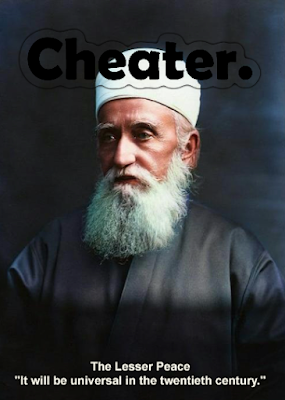
Another terrible Tablet of Baha'u'llah that Baha'is are ashamed to translate and distribute.

Another terrible Tablet of Baha'u'llah I wish to nominate is the Lawh-i Istintáq, also known as the Tablet of Inquisition. The reasons are more serious and macabre than for other tablets discussed.

The tablet deals with the murder of 3 Azali's (Sayyid Muhammad Isfahani, Aqa Jan Kaj-Kulah and Mirza Rida-Quli Tafrishi) in Akka by a gang of 7 Baha'is -- the intimate companions of Baha'u'llah -- shortly after their arrival in Akka.

What's striking about this Tablet is that despite all the posturing by Baha'is about this situation, and the suggestion that the 7 Baha'is were not under Baha'u'llah's explicit or implied instruction to commit a triple homicide, Baha'u'llah actually outed himself with this verse: -

"Verily the Mute [al-akhras, Isfahani] called himself 'Quddus' and hath claimed what the Evil Whisperer (al-khannas) claimed for himself. The other one [Aqá Ján] called himself the 'Sword of Truth' (sayfu'l-haqq);; he said: 'I, verily, am the conqueror of the cities'. God hath sent the one who hath smitten upon his mouth, so that all may firmly believe that through this Satan's tail hath been cut off by the sword of the Merciful (sayfu'r-rahmán)."

- Baha'u'llah, Lawh-i Istintáq

Clearly, Baha'u'llah was pleased and believed they got what they deserved. This is further evidence that Baha'u'llah was at the very least complicit in serious criminal behaviour throughout his life. He deserved every minute of his jail time and exile and deserved far worse treatment than he actually received.

This is another tablet that Baha'is are ashamed to translate and distribute.

The story of the murder of Siyyid Muhammad-i-Isfahani, Aqa Jan-i-Kaj-Kulah, and Mirza Rida-Quliy-i-Tafrishi by a group of 7 Bahai's in Akka is well-documented in Baha'i history (e.g. Baha'u'llah: The King of Glory by Hasan M. Balyuzi)

We know that Baha'u'llah denied wrongdoing, and publicly denounced the murders, but in the Tablet of Interrogation he clearly states that the three murdered men deserved it (See above)

Here, I've asked ChatGPT for its opinion on this situation and on the moral implications of Baha'u'llah's writings:-


Three ways for Shoghi Effendi's followers to interpret Shoghi Effendi's unexpected death

Shoghi Effendi with Ruhi Afnan

1. Even though Shoghi Effendi appointed no successor, a successor must be found, because even if it is not clear who the legitimate successor is, it is more important for the institution of Guardianship to just continue. This is the position of the Orthodox Baha'is.

2. Shoghi Effendi appointed no successor so the institution of Guardianship must end. But we will go off and create the Universal House of Justice on our own, and give it powers which were previously under the domain of the Guardian (e.g. excommunication). This is the position of Haifan Baha'is.

3. Shoghi Effendi appointed no successor so the institution of Guardianship must end. But the Guardianship and the Universal House of Justice were designed to complement each other - one cannot exist without the other - so the Baha'i Faith must continue with neither a Guardian nor a Universal House of Justice. No one supports this view for some reason.

Shoghi Effendi's writings certainly do not seem to support option (2):

It should be stated, at the very outset, in clear and unambiguous language, that these twin institutions [Guardianship and the UHJ] of the Administrative Order of Bahá’u’lláh should be regarded as divine in origin, essential in their functions and complementary in their aim and purpose. Their common, their fundamental object is to insure the continuity of that divinely-appointed authority which flows from the Source of our Faith, to safeguard the unity of its followers and to maintain the integrity and flexibility of its teachings. Acting in conjunction with each other these two inseparable institutions administer its affairs, coördinate its activities, promote its interests, execute its laws and defend its subsidiary institutions. Severally, each operates within a clearly defined sphere of jurisdiction; each is equipped with its own attendant institutions—instruments designed for the effective discharge of its particular responsibilities and duties. Each exercises, within the limitations imposed upon it, its powers, its authority, its rights and prerogatives. These are neither contradictory, nor detract in the slightest degree from the position which each of these institutions occupies. Far from being incompatible or mutually destructive, they supplement each other’s authority and functions, and are permanently and fundamentally united in their aims.

Divorced from the institution of the Guardianship the World Order of Bahá’u’lláh would be mutilated and permanently deprived of that hereditary principle which, as ‘Abdu’l‑Bahá has written, has been invariably upheld by the Law of God. “In all the Divine Dispensations,” He states, in a Tablet addressed to a follower of the Faith in Persia, “the eldest son hath been given extraordinary distinctions. Even the station of prophethood hath been his birthright.” Without such an institution the integrity of the Faith would be imperiled, and the stability of the entire fabric would be gravely endangered. Its prestige would suffer, the means required to enable it to take a long, an uninterrupted view over a series of generations would be completely lacking, and the necessary guidance to define the sphere of the legislative action of its elected representatives would be totally withdrawn.

Severed from the no less essential institution of the Universal House of Justice this same System of the Will of ‘Abdu’l‑Bahá would be paralyzed in its action and would be powerless to fill in those gaps which the Author of the Kitáb-i-Aqdas has deliberately left in the body of His legislative and administrative ordinances.

--Shoghi Effendi, World Order of Baha'u'llah

A number of people are leaving the Baha'i faith because of the bad policies of the UHJ.


I have been a Baha'i for nearly 25 years. I've been actively involved during this time with various committees at local and national levels. I am still a Baha'i but it's becoming progressively harder for me to continue to believe. I am not wanting to have an argument with anyone, create doubts or disunity. I just want to share some of the problems that I feel in the hope of hearing others' advice and whether they feel the same.

As time has gone on I've felt an increasing disconnect with the vision of the Faith which has been spelled out in the plans from the House of Justice. Since the 2000s when Ruhi started, the Faith seems primarily focussed on expansion. The most recent 9 Year Plan seems to be taking this to a whole new level. I have been involved in the plans over the years and can't help but feel that we're spending a lot of energy offering the Faith where it isn't wanted - at least in the developed Western Country where I live. In the time I've been involved with the plans, I've only seen an handful of people declare. During this time I've seen many more go inactive or leave the Faith. I have been left wondering why we have been so outwardly focussed when we can't even retain people who are already in the Faith.

In an effort to understand things better, I looked through messages of the House going back to the 1960s. I saw that there had been times we had been promised that mass enrolment was just around the corner. There were other times when the House was clearly alluding to the outbreak of World Peace by the end of last Century. Yet here we are with war in Europe and the numbers of Baha'is in many Western countries in decline (according to census data anyway). If the House missed the mark previously, how can we be sure we are being divinely guided? As I get older and see more things in the world, the basic notion of an infallible group of men is becoming harder to accept.

It's also hard for me to visualise how the Faith will become the majority religion of the planet when it can't maintain its own membership and engage them in the activities of the Plan. The vast majority of Baha'is I know don't get involved with the institute process and cluster meetings. From the conversations that I've had, this is because many people feel it is too institutionalised and feels like proselytising - and these are the people who believe in Baha'u'llah, 'Abdu'l-Baha and the Guardian.

"I agree entirely as regards the uselessness of Ruhi." Sen McGlinn


I agree entirely as regards the uselessness of Ruhi. It has been a colossal disaster for the Bahai community.

As regards the year 2000 "prophecy," it was a misunderstanding, widely shared in western Bahai communities (ie those that use the Gregorian calendar), and by the House of Justice, which reflects the understanding and misunderstanding of the community that elects it. Abdu'l-Baha was not a Gregorian, he used the Persian calendar, the Hijri calendar and the Syrian calendar. And in any case, for him "this century" meant the dispensation of Baha'u'llah, not a period of 100 years. He wrote, for example:

The Spiritual Assemblies to be established in this Age of God, this holy century, have… had neither peer nor likeness in the cycles gone before.

(Selections from the Writings of ‘Abdu’l-Baha, page 82)

The teachings of Baha’u’llah are the light of this age and the spirit of this century.

(Selections from the Writings of ‘Abdu’l-Baha, page 107)

In every century a particular and central theme is, … confirmed by God. In this illumined age that which is confirmed is the oneness of the world of humanity.

(Selections from the Writings of ‘Abdu’l-Baha, page 114)

Gradually whatsoever is latent in the innermost of this Holy Cycle shall appear and be made manifest, … Ere the close of this Century and of this Age, it shall be made clear and manifest how wondrous was that Springtide …

(quoted in Shoghi Effendi, Baha’i Administration, p. 16)

… in any of the past cycles and dispensations, no assemblies for women have ever been established … This is one of the characteristics of this glorious Dispensation and this great century.

(Compilation on Women,)

I’ve selected these examples because century is used in parallel with other terms, so those who know no Persian can see what is meant. The words used for "century" in each case do not mean "100 years", and in any case would not mean a Gregorian century. So the "prophecy" was a mistake, and had serious effects. Believing that the Lesser peace, or the unity of nations, was due in the Gregorian 20th century, the House of Justice made plans accordingly. Ruhi arose from the UHJ's lack of faith in the ability of the local and national assemblies to mature in time for the y2k deadline, and the big building projects on Mt Carmel were rushed to meet the same deadline. The UHJ supposed that the Bahai community was about to become a big player in world affairs and needed to be in touch with "prominent people," and needed and expected mass enrollments. That timeline was all wrong, but we are still stuck with the domination of the Ruhi institutes and sinking into obscurity, except in Iran.

An open letter to Augusto Lopez-Claros by a concerned Baha'i

Dr Augusto Lopez-Claros is currently Chair of Global Governance Forum. He is an economist with over 30 years of experience in international organisation and has worked in a number of senior roles at the World Bank, where he was Director of the Global Indicators Group, at the World Economic Forum, where he was Chief Economist and the International Monetary Fund. He has published extensively on a range of economic development topics and issues of international cooperation and has also lectured at some of the world’s leading universities, think tanks and international organisations. His latest books are Equality for Women = Prosperity for All (2018, St. Martin's Press) and Global Governance and the Emergence of Global Institutions for the 21st Century (2020, Cambridge University Press). By Faith he is a follower of the Baha'i Faith.

This is an open letter to Dr Augusto Lopez-Claros who shares with the Baha'is commitment to the ideals and principles of the Baha'i Faith. One of the principles of the Baha'i Faith is not to involve in the politics but Dr. Augusto, a Baha'i of international repute is openly going against this very clear principle of the Baha'i Faith, set alive by our Master Abdul Baha, and defaming our institutions, specially, the Universal House of Justice, thus labeling them with a tag of hypocrisy.

1. A Vision of Democracy for the Next 100 Years

You were one of the speakers at the 100th Anniversary of Swedish Democracy, it was arranged by the Baha'i community of Sweden. Obviously you were invited to speak but you used the figure of 'Abdu’l-Bahá, one of the central figure of the Baha'i faith during the period 1892-1921, who coincidentally passed away 100 years earlier, you tried to impress the gathering about the Baha'i Faith, by presenting its ideas and principles which would assist in protecting and enhancing the practice of democracy over the next century. Starting with your speech you tried to impress the lady prime-minister that it was the blessing of Abdul Baha that Sweden has a women prime-minister. You could have concluded your speech without the mention of the Baha'i Faith, let me tell you the audience did felt at ease and thought  that you were trying to push Baha'i ideas into their minds. This is politics.

https://www.youtube.com/watch?v=I_0tGxvSrX4

2. Equality of opportunity as a Driver of Prosperity: The Case of Iran 

You are openly criticizing the Govt. of Iran on their treatment of the minorities. You have accused them for unequal treatment of the Baha'i minorities, the law, and violation of people’s human rights. You say this has adversely affected various metrics of human welfare and development but you failed to criticize the inhuman and unjustified sanctions by the United States. This is nothing but involvement of oneself in politics which as a Baha'i you should haven’t done.

You are fully aware that these statements will become a cause for pushing the Govt. of Iran for more persecution. It brings a bad name to the Faith that at one hand we are called for non-involvement in politics and on the other hand Baha'i intellectuals are openly indulging in politics.

3. Russia Must Pay for Ukraine´s Reconstruction

You called the war between Ukraine and Russia terming as unprovoked and labelling Russia as the aggressor, forgetting that as a Baha'i you shouldn’t have gone for analyzing a political issue and that too one sided. At the same time, you failed to criticize the devastating sanctions imposed on Russia and its grave implications, including a freeze on the international reserves of the Central Bank of Russia. The stock market has more or less been wiped out, the ruble has come under huge pressure and there is a long list of major global corporations which have announced their departure from the Russian markets. 

You said, The war in the Ukraine is a golden opportunity that must not be wasted. It should be used to rewrite the rule book on the consequences of armed aggression. You wanted that Russia should know that it will have to pay the final bill. In the most literal sense of the word. In the meantime, you did warn and threatened the Russian people of its consequences.

Dear Aquino have you ever in the past gave this type of warning to the US aggression in Afghanistan and Iraq or the daily aggression of the State of Israel against the people of Palestine?

You may be a successful intellectual but you failed to comply yourself with the Baha'i principles and put to shame the Baha'is and the Baha'i Administration.

At the end I would quote the writings of our beloved Guardian Shoghi Effendi that shows that your behavior is against the Baha'i principles and you failed to live with high Baha'i standards. I would request you, in the best interest of the Faith to please resign from your post and request the Universal House of Justice to impose administrative sanctions on you.

As the beloved Guardian has stated: “Let them refrain from associating themselves, whether by word or by deed, with the political pursuits of their respective nations, with the policies of their governments and the schemes and programs of parties and factions. In such controversies they should assign no blame, take no side, further no design, and identify themselves with no system prejudicial to the best interests of that worldwide Fellowship which it is their aim to guard and foster.” For Baha’is to be drawn into such conflicts would be futile and would only perpetuate the culture of contest deranging human affairs; it would also divide the community and prevent it from making any significant contribution to the betterment of the world.

(Letter by Universal House of Justice to The National Spiritual Assembly of the Baha’is of the Russian Federation dated: 20 August 2014)

Sender's name withheld for security reasons.