BAHA'I FAITH IS A CULT AND CONDONES SEXUAL ASSAULT AND GROOMING


This is the story of my experience in the Baha'i community:

I started participating as a JY facilitator after looking for extracurricular activities that would look good on my college applications. I was 15 turning 16 and never heard of the faith but was intrigued by their values and actions. I cared that they were part of the community, mainly working within a Latiné neighborhood. Everyone was extremely caring and hospitable. We worked out of a community house where 5 women in their late 20s lived but anyone could come and go and utilize the space. I soon started going more often than once a week outside of the weekly JY meetings. They cooked food for everyone, held gatherings where I could meet new people and I was invited to their fully paid overnight camps. Of course, I wanted to participate more in everything they offered, I was an impressionable teenager from a complicated home life. So I began working almost every day of the week volunteering my hours and practically living in the house. I should say that I have never been religious, even through my Catholic childhood and all the bahai propaganda I was subjected to, I will remain an atheist.

Eventually, I met a 20-year-old woman who had just left college and couldn't return to her family home, so she moved into the house. Soon after she moved in our relationship became flirtatious and romantic. She knew I was still in high school and 15 at the time. We were left alone in the house and it became obvious to the other women in the house that a romantic relationship had sparked between us. Today, I do not refer to this situation as a mutual, romantic relationship. I was groomed by an older person and used when I was new to my sexuality and to sex. The older women in charge of the house knew about this and never spoke with me. They spoke with the groomer but she continued to hurt me after they spoke with her. It wasn't until much later that I understood what happened to me and the reaction and abuse of power by the people caring for underage kids.

Before I left for college, one of the women living in the house, who was also a trusted friend (a bahai but not active in the faith), explained that she was raped by another bahai in the house around the same time I was groomed. She was younger than most of the other women living in the house so she asked for advice from another, older roommate. Her response was for my friend to forgive the rapist. Nothing ever came out of the situation, charges were never pressed against him and he continued to work with women and children.

I do not tolerate anyone condoning or refusing to hold a rapist accountable. As a woman, I will never understand how another person, especially another woman, could excuse any sexual abuse. She was raped around the same time I came into the faith and I was only discovering this by the end of my participation. After she told me, I completely ghosted every person in the bahai community without explaining to anyone why I left.

Throughout 3 years I was involved with the bahai community, I witness clear proselytization, abuse of power, cult-like actions (bahais only associating themselves with other bahais, manipulation, the emphasis on global unity through the faith), grooming, SA, hypocrisy, etc.

The reason for this post is to share with people my experience. Even if a couple of years have passed since I was in the community, all of their actions still haunt me and I feel for anyone else hurt by the reckless and contradicting behavior of the people who call themselves "bahais". The people who were meant to protect and care for children and teens still contact me today and have not owned up to their cruelty.

Source : https://www.reddit.com/r/exbahai/comments/149sz7k/bahai_faith_is_a_cult_and_condones_sa/
"In this Dispensation, divine guidance flows on to us in this world after the Prophet’s ascension, through first the Master, and then the Guardians."

While the Guardianship was to be a perpetual institution of the Administrative Order, it ceased to exist after the death of Shoghi Effendi because he died having violated Bahá'u'lláh's command in the Kitáb-i-Aqdas that "Unto everyone hath been enjoined the writing of a will." Having no children of his own and having declared every living male descendant of Bahá'u'lláh a Covenant-breaker, Shoghi Effendi left no eligible candidates for the office of Guardian, posing a serious problem given his assertion that "In this Dispensation, divine guidance flows on to us in this world after the Prophet’s ascension, through first the Master, and then the Guardians." He had furthermore stated in The World Order of Bahá’u’lláh that...

Divorced from the institution of the Guardianship the World Order of Bahá’u’lláh would be mutilated and permanently deprived of that hereditary principle which, as ‘Abdu’l-Bahá has written, has been invariably upheld by the Law of God. “In all the Divine Dispensations,” He states, in a Tablet addressed to a follower of the Faith in Persia, “the eldest son hath been given extraordinary distinctions. Even the station of prophethood hath been his birthright.” Without such an institution the integrity of the Faith would be imperiled, and the stability of the entire fabric would be gravely endangered. Its prestige would suffer, the means required to enable it to take a long, an uninterrupted view over a series of generations would be completely lacking, and the necessary guidance to define the sphere of the legislative action of its elected representatives would be totally withdrawn.


So fundamental was the office of the Guardianship, that Bahá’í literature was significantly altered subsequent to Shoghi Effendi's death, with the notable removal of references to "The First Guardian of the Bahá'í Faith," the "first and present Guardian," and "the lineage of succeeding Guardians." In some cases, references to the Guardian have been replaced or amended with "the Universal House of Justice" and in other instances references to the duties of the Guardian that were in the present tense have been changed to the past tense, indicating that the Guardianship has ceased.

From 'Abdu'l-Bahá's Will and Testament...

O ye beloved of the Lord! It is incumbent upon the Guardian of the Cause of God to appoint in his own life-time him that shall become his successor, that differences may not arise after his passing. He that is appointed must manifest in himself detachment from all worldly things, must be the essence of purity, must show in himself the fear of God, knowledge, wisdom and learning. Thus, should the first-born of the Guardian of the Cause of God not manifest in himself the truth of the words:—“The child is the secret essence of its sire,” that is, should he not inherit of the spiritual within him (the Guardian of the Cause of God) and his glorious lineage not be matched with a goodly character, then must he, (the Guardian of the Cause of God) choose another branch to succeed him." 

https://www.reddit.com/r/exbahai/comments/129fb9f/biggest_theological_problems_in_bahai_teaching/ 

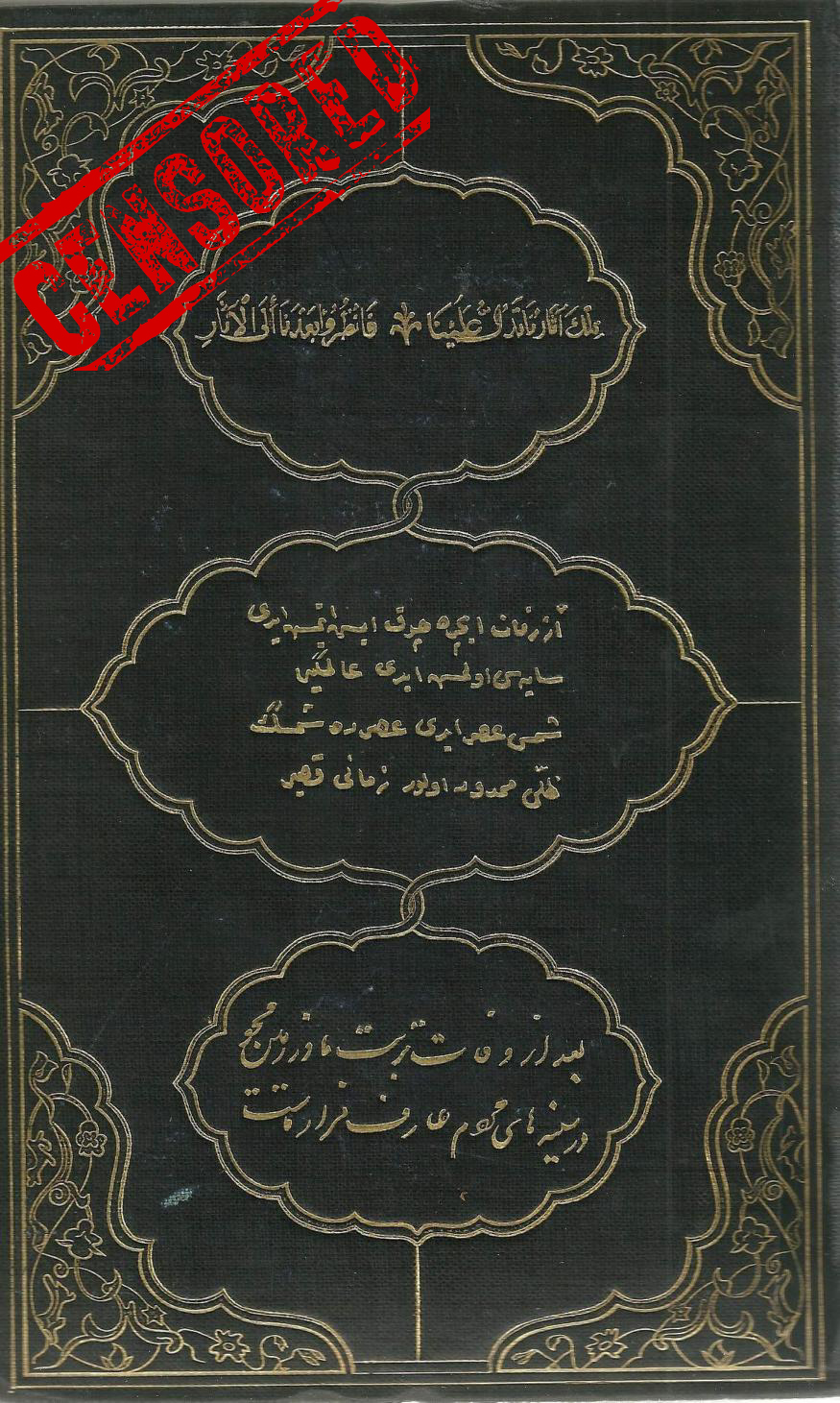
A list of some censored books on the Baha'i Faith

Kitab-i-Nuqtatu'l-Kaf

Here's a list of some censored books on the Baha'i Faith. These books were all suppressed by the Baha'i authorities, and in some cases, the authors were killed.

It would be great to see a more organised effort to distribute and translate these Persian works. Please feel free to add to the list, or share translations if you are aware of any.

​

  • Nuqtatu'l-Kaf
    • Nuqtatu'l-Kaf is a book that was originally published in 1851 but was suppressed in Iran. It contains material that is hostile to the Baha'i Faith. When E.G. Browne published the book with Persian and English introductions, a number of Baha'i scholars worked on refutations of the book, including Siyyid Mahdi Gulpaygani and Mirza Abu'l-Fadl. The book was discovered by E.G. Browne in Paris and published by him. This horrified Baha'i leaders who accused him of having become an Azali and of receiving a bribe from them to publish the book.
  • The Philosophy of Niku (Filsifa-i-Niku)
    • Even after he had given up the Baha’i faith, the Baha’is of Teheran continued to claim him as one of their own, and Niku was forced to write several volumes in Persian entitled “The Philosophy of Niku,” to prove that he had left the movement. In an able and interesting manner, Niku described the things which he had seen and heard which disillusioned him, such as the worldly ambition of Abdu’l-Baha, his greed for money, and his flattering epistles to great and wealthy people whom he hoped to win as disciples.
  • Hash Bihisht (The Eight Paradises)
    • The Hasht Bihisht is a book written by two sons-in-law of Subh-i-Azal, which contains the teachings and sayings of Haji Sayyid Jawad of Karbala, who was among the first Letters of the Living in the Bayan hierarchy. The book's preface discusses the virtues and claims of the Bayan religion over all other religions, while the body of the work consists of eight chapters dealing with the practice of the Bayan religion and the events of the Day of Resurrection. The book also contains an Elucidation of the Direful Mischief, which refers to the secession between the Azalis and the Bahais, and ends with a narrative of a visit to Acre by one of the people of the Bayan, Mirza Aqa Khan of Kerman, who was also one of the co-authors of the book. The work is considered a systematic treatise in the philosophy, theory, ethics, morality, and history of the Bayan religion.
  • Kitab-i-Subhi
    • The Kitab-i-Subhi, written by Mirza Subhi, a former Persian scribe to Sir Abbas Effendi and a Bahai missionary. He wrote two books explaining why he left the Baha'i faith.
  • Kashf-al-Hiyal (Exposure of Deception)
    • The book Kashf-al-Hiyal was written by Abd-al-Husayn Avarih, who was a Bahá'í and had also written the Kavakibu'd-Durriyyih, an important history of the Bahá'í Faith. However, he later left the Bahá'í Faith and wrote the Kashf-al-Hiyal in three volumes. In the book, he related how he became a Bahá'í and why he defected. He also mentioned that while writing the history of the movement, Abdu’l-Baha forced him to misrepresent the facts. Avarih was a member of the Hands of the Cause and a prominent Bahá'í missionary who was greatly revered by the Bahá'ís. He served Shoghi Efendi for a number of years and was sent by him to Europe to make converts but later left the movement. In Kashf-al-Hiyal, Avarih confirmed the account of Hasht-Bihisht and added that the assassins of Baha's brother Mirza Musa were Ustad Muhammad Ali the Barber and his accomplices.
  • Book of Seraj
  • Book of Qahir
  • Tanbihun-Naimin
    • The Tanbihun-Naimin, also known as The Awakening of the Sleepers, is a book comprising four parts. The first part is a facsimile of a letter from Abdul Baha to his aunt known as Khanum-i-Buzurg, urging her to believe in Baha and to renounce his half-brother Subh-i-Azal. The second part is a long reply from Khanum-i-Buzurg, commonly called Risala-i Amma, containing historical and biographical information about the Bahais, particularly during the Baghdad period and the schism between the Bahais and Azalis. The reply rebuts the claims of Baha'u'llah. The third part is a homily in Arabic followed by a refutation in Persian, both by Mirza Ahmad of Kerman. The fourth part is a facsimile of the Will and Testament of Baha, with the preamble and concluding notes in Baha's handwriting and the body of the will in his secretary's handwriting.

https://www.reddit.com/r/exbahai/comments/11pev32/censored_books_on_the_bahai_faith/

Baha'u'llah - A Serial Murderer

Baha'u'llah

It's known that Baha'u'llah's ambitions for leadership created a trail of homicides across the Middle East, several of which are acknowledged even by Baha'i sources.

Baha'u'llah was involved in upwards of 20 homicides, including prominent Babis who didn't accept his claims to be HWGSMM and Azalis who opposed him. This is not to count Baha'u'llah's involvement in organising military insurgencies where many hundreds died.

Is there a complete list of the known victims of these crimes?

Here are a few I've gathered:

Hajji Mirza Ahmad of Kashan -- murdered in Baghdad, author of the early Babi history Kitab-i Nuqtat al-Kaf, a Babi who was loyal to Subh-i-Azal

Mirza `Alī Muhammad Sarrāj -- murdered in Baghdad by stabbing, author of a book opposing the claim that Baha'u'llah was HWGSMM

Sayyid Ismail Zawareh -- murdered in Baghdad, his throat was cut and the knife placed in his hand to make it look self-inflicted

Aqa Ali Muhammad -- murdered in Baghdad, a brother-in-law of the Bab

Aqa Abul Jasim of Kashan -- murdered in Baghdad, "because he had reported to Subh-i Azal that he heard that Baha’s pretension was that he was the return of the Imam Hussein"

Mullā Rajab `Alī (Qahir) -- murdered in Karbala, brother of Sarraj and a supporter of Subh-i-Azal. He was murdered with a revolver by a Baha'i man called Nasur the Arab.

Aqa Sayyid Ali the Arab -- murdered in Tabriz

Mirza Nasrullah -- murdered in Edirne, the brother-in-law of Subh-i-Azal

Mulla Rajab Ali Qahir -- murdered in Karbala, a brother-in-law of the Bab

Haji Mirza Muhammad Rida -- murdered in Akka, maternal uncle of Haji Sayyid Muhammad of Isfahan

Sayyid Muhammad Isfahani -- murdered in Akka, a supporter of Subh-i-Azal, seven Baha'is were convicted and jailed

Aqa Jan Kaj-Kulah -- murdered in Akka, a supporter of Subh-i-Azal, seven Baha'is were convicted and jailed

Mirza Rida-Quli Tafrishi -- murdered in Akka, a supporter of Subh-i-Azal, seven Baha'is were convicted and jailed

Muhammad Khan -- murdered in Akka, murdered in the Carawansaray of corn-sellers, buried in a shallow grave and discovered by authorities

Hajji Ibrahim -- murdered in Akka, murdered in the Carawansaray of corn-sellers, buried in a shallow grave and discovered by authorities

Source : https://www.reddit.com/r/exbahai/comments/11jgnv4/bahaullah_a_serial_murderer/

Baha'i cultists remove two quotes from Ruhi Book-1 to make it more tolerant!


The Baha'i administration has been actively deceiving simple minded people to join their cult through various means, including through the Core Activities.

Ruhi Book-1 is the first book taught in a Ruhi Study Circle and introduces basic concepts and principles of the Baha'i Faith. It is designed to help "seekers" (potential Baha'is) understand the teachings of the Baha'i Faith and explore its relevance to their lives!

Recently, two quotes were removed from the latest revised edition of Ruhi Book-1. These quotes were deemed inappropriate by the Baha'i administration and were removed to make the book more tolerant and welcoming to "seekers". The quotes in question are:

"Whoso hath failed to recognize Him will have condemned himself to the misery of remoteness, a remoteness which is naught but utter nothingness and the essence of the nethermost fire."

"The souls of the infidels, however, shall—and to this I bear witness—when breathing their last be made aware of the good things that have escaped them, and shall bemoan their plight, and shall humble themselves before God. They shall continue doing so after the separation of their souls from their bodies.”

While it is understandable that the Baha'i cultists wants to present a more tolerant and welcoming image to seekers, the removal of these quotes raises questions about the authenticity of the teachings of the Baha'i Faith. It is important to note that these quotes were part of the original teachings of the Baha'i Faith and were included in previous editions of Ruhi Book-1!

This approach involves presenting a rosy picture of the Baha'i faith to attract interested individuals, while ignoring or censoring certain quotes and teachings from the original writings of the Baha'i central figures.

There is a growing concern among some Baha'is that the Baha'i administration is hiding certain aspects of the faith and only presenting a sanitized version of the teachings to the Baha'is of western countries. This concern has led to many Baha'i scholars leaving the faith, as they feel that the censorship policy goes against the principles of transparency and honesty.

It is essential that the Baha'i community and its administration recognize the importance of presenting the teachings of the Baha'i faith in an honest and transparent manner. This includes acknowledging and addressing uncomfortable or controversial aspects of the faith, not hiding or censoring them.